Jaroslav Peregrin - hlavní nedávné publikace


KNIHY:
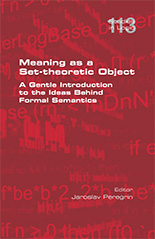 | Meaning as a set-theoretic object, College Publications, London, 2025 Any comprehensive account of natural language must involve an answer to the question What is meaning? Fifty years ago, a radical attempt to answer such question, and to provide not only as comprehensively as possible, but also an explicitly as possible, was made by the founding fathers of what has become known later as formal (or model-theoretical) semantics (Montague, D. Lewis, Cresswell, …). They basically followed Frege in situating meanings in the "third realm", different from the realm of physical, spatio-temporal things and also from the realm of mental contents. They, however, made use of the fact that since Frege's time the realm has been thoroughly researched and mostly colonized by set theory. Therefore, formal semanticists took meaning to be a set. This approach to semantics yielded a vast number of interesting results both concerning the logico-philosophical nature of meaning and concerning particular meanings of various natural language expressions. Yet I think that the general contribution of formal semantics to our understanding of meaning still waits for a thorough evaluation. And this is something I would like to undertake in this book. As the heyday of formal semantics is long over now, we can consider it with the benefit of hindsight; and I think that with such a detachment we can see things which are not so clearly seen before. | |
 | Normative Species: How Naturalized Inferentialism Explains Us, Routledge, New York, 2024 This book is about rules, and especially about human capability to create, maintain and follow rules, as a root of what makes us humans different from other animals. The leading idea is that scrutinizing this capability is able to tell us who we humans are and what kinds of lives we live. It elaborates Wilfrid Sellars' visionary observation that "to say that man is a rational animal, is to say that man is a creature not of habits, but of rules"; and it builds on the ideas of Sellars' and Brandom's inferentialism, in a novel naturalistic version. The main tenet of inferentialism is that our language games are essentially rule-governed and that meanings are inferential roles. I see the task of reconciliation of inferentialism and naturalism as centered around the problem of naturalization of rules. I argue that the most primitive form of a rule is a cluster of normative attitudes. We humans are specific by our tendency to turn our attitudes on the attitudes themselves, and to do so in a specific way, which turns our "second-order" attitudes into "normative" ones. This self-reflective structure characterizes our ability to create, maintain, and follow systems of interconnected rules. Furthermore, I shows how our most important system of rules—that constitutive of our language—helped to lead us to our current position of rule-following, ultra-social, rational, and discursive creatures. | |
  | Člověk jako normativní tvor, Academia, Praha, 2022 Kniha se skládá z mírně upravených verzí článků, které jsem v posledních zhruba osmi let publikoval doma i v zahraničí. Všechny ty texty se točí kolem jednoho tématu, kterým je role pravidel v životě lidí, a vedou k překvapivému závěru, že to, co nás lidi odlišuje od jiných tvorů, je právě schopnost vytvářet a udržovat pravidla a řídit se jimi. Člověk je tedy, podle tohoto závěru, vpravdě normativní tvor. | |
 | Člověk v zrcadle teorie her, Dokořán, Praha, 2021 Vyplácí se spolupracovat a je důvěra v jiné lidi racionální? Je člověk Homo economicus? Jak mohly vzniknout základy lidské komunikace? Produkuje evoluce zákonitě sobce? Takové otázky si kladou vědci i filosofové a s odpovědí na ně nám může pomoci i teorie her. Ta vznikla v polovině minulého století jako matematický aparát, který měl lidem pomoci se orientovat a rozhodovat ve složitých a zejména konfliktních situacích. Brzy si však začala hledat uplatnění i daleko za hranicemi ekonomie, na niž se nejprve soustředila; dnes proniká do sociologie, politologie i jiných společenských věd, do evoluční teorie a samozřejmě i do filosofie. Tato knížka se pokouší přístupným, nematematickým způsobem objasnit, na jaké filosofické problémy nám tato teorie může pomoci vrhnout světlo. | |
 | Philosophy of logical systems, Routledge, New York, 2019 This book addresses the hasty development of modern logic, especially its introducing and embracing various kinds of artificial languages and moving from the study of natural languages to that of artificial ones. This shift seemed extremely helpful and managed to elevate logic to a new level of rigor and clarity. However, the change that logic underwent in this way was in no way insignificant, and it is also far from an insignificant matter to determine to what extent the "new logic" only engaged new and more powerful instruments to answer the questions posed by the "old" one, and to what extent it replaced these questions with new ones. Hence, this movement has generated brand new kinds of philosophical problems that have still not been dealt with systematically. Philosophy of Logical Systems addresses these new kinds of philosophical problems that are intertwined with the development of modern logic. Jaroslav Peregrin analyzes the rationale behind the introduction of the artificial languages of logic; classifies the various tools which were adopted to build such languages; gives an overview of the various kinds of languages introduced in the course of modern logic and the motifs of their employment; discusses what can actually be achieved by relocating the problems of logic from natural language into them; and reaches certain conclusions with respect to the possibilities and limitations of this "formal turn" of logic. | |
 | Co je nového v logice?, Nová Beseda, Praha, 2018 Kniha populárním způsobem shrnuje některé pozoruhodné trendy v nedávném a současném vývoji logiky. Stav logiky nyní, na počátku jedenadvacátého století, je takový, že poté, co pro své účely zrekrutovala metody moderní matematiky, se logika rozvětvuje do čím dál větší šířky. Nejenom že vedle kalkulu klasické logiky, která byla dlouho považována za tu jedinou skutečně správnou, stále vznikají nové a nové alternativní kalkuly, ale alternativy se objevují k samotným dříve zdánlivě samozřejmým principům budování kalkulů. Logika navíc, poté co se vymezila oproti svým sousedům, jako je psychologie, lingvistika, či metafyzika, začíná s těmito sousedy opět obcovat a vytvářet plodné aliance. Nadále prohlubuje své propojení s matematikou, ale prohlubuje i kritickou reflexi toho, co jí matematika a matematické modely reálného usuzování skutečně přinášejí. | |
 | Filosofie logiky [spoluautor Vlasáková, M.], Filosofia, Praha, 2017 Kniha je soustavným pojednáním o problémech filosofie logiky a přístupech k jejich řešení; je ovšem napsána trochu jinak, než bývají knihy o filosofii logiky po světě obvykle psány. Na jedné straně se snaží ukazovat, že problémy, s nimiž logika a filosofie logiky zápasí, často vznikly mnohem dříve než v době, kdy se objevila moderní logika; na druhé straně se ale snaží ukázat, že je tu specifický druh filosofických problémů týkajících se logiky, který skutečně vznikl až se vznikem moderní logiky a kterému dosud není věnována patřičná pozornost. Kromě tradičních témat (například problematika logických paradoxů, vymezení logické formy, logické zachycení „obecnin“ aj.) se tudíž práce zabývá i ryze novodobými problémy logiky (spojenými například s axiomatizací logických kalkulů a vytvářením jejich množinových modelů, s otázkou jejich úplnosti a neúplnosti, či s bující pluralitou logických systémů). Kniha je psána tak, aby byla srozumitelná nejenom úzkému okruhu odborníků; je tedy vhodná pro studenty různých oborů, kteří přicházejí s logikou do styku, i pro zájemce o logiku z řad široké odborné veřejnosti. | |
 | Reflective equilibrium and the Principles of Logical Analysis:
Understanding the Laws of Logic [spoluautor Svoboda, V.], Routledge, New York, 2017 This book offers a comprehensive account of logic that addresses fundamental issues concerning the nature and foundations of the discipline. The authors claim that these foundations can not only be established without the need for strong metaphysical assumptions, but also without hypostasizing logical forms as specific entities. They present a systematic argument that the primary subject matter of logic is our linguistic interaction rather than our private reasoning, and it is thus misleading to see logic as revealing “the laws of thought”. In this sense, fundamental logical laws are implicit to our "language games" and are thus more similar to social norms than to the laws of nature. Peregrin and Svoboda also show that logical theories, despite the fact that they rely on rules implicit to our actual linguistic practice, firm up these rules and make them explicit. By carefully scrutinizing the project of logical analysis, the authors demonstrate that logical rules can be best seen as products of the so called reflective equilibrium. They suggest that we can profit from viewing languages as “inferential landscapes” and logicians as “geographers” who map them and try to pave safe routes through them. This book is an essential resource for scholars and researchers engaged with the foundations of logical theories and the philosophy of language. | |
 | Inferentialism: why rules matter, Palgrave, Basingstoke, 2014 The term "inferentialism", coined by Robert Brandom, has become a trademark of a certain position in the philosophy of language which claims that meanings identify with inferential roles - a radical departure from more traditional semantic approaches. Independently of this, the term is now cropping up in logic, in connection with positions prioritizing proof-theory over model theory and approaching meaning in logical, especially proof-theoretical terms. The book brings these two strands together: it reviews and critically assesses the foundations of Brandomian inferentialism, it proposes upgrades, and it clarifies its relationship to inferentialism in logic. Emphasis is laid on clearly articulating the general assumptions on which inferentialism rests, thus elucidating its foundations, followed by discussing the consequences of this standpoint, and then dealing with the most intensive objections raised against the standpoint. | |
 | Jak jsme zkonstruovali svou vlastní mysl, Dokořán, Praha, 2014 Současné názory na povahu lidské mysli, jak nám je zprostředkovává kognitivní věda či filosofie mysli, oscilují mezi dvěma extrémními polohami: jednou z nich je názor, že mysl je prostě činnost mozku; druhý je pak názor, že mysl jakožto prostor obsahující myšlenky, pocity ap. je spíše jenom jakýsi metaforický obraz, je to konstrukt, který je výsledkem nějakých našich "interpretačních praktik". Tyto názory se zdají navzájem vylučovat; a přitom každý z nich se zdá mít v něčem pravdu: zdá se být nepochybné, že mysl je nějak reálná a je věcí mozku; ale zdá se tomu být i tak, že to, že náš normální hovor o mysli se vztahuje k něčemu, co se nikde hmatatelně nevyskytuje. V této knize hájíme názor, že tyto dva pohledy jsou slučitelné; že tedy můžeme (a měli bychom) přijmout názor, že to, čemu říkáme mysl, jsme sice zkonstruovali, ale přesto je to navýsost reálná věc. | |
 | Člověk a pravidla, Dokořán, Praha, 2011 Poté, co byla za víceméně jednotící rámec současných věd o živé přírodě přijata evoluční teorie a co si tato teorie čím dál častěji nachází cestu i do věd společenských, se před vědci otevírá problém prozkoumání toho, jakým způsobem se v rámci evoluce mohl objevit člověk, tvor s tolika rysy nepodobnými vlastnostem svých zvířecích bratranců. To, co je v současné době v tomto kontextu v centru pozornosti, je otázka evolučního vysvětlení vzniku spolupráce. Kniha poukazuje na fakt, že problém vzniku pravidel s problémem vzniku spolupráce úzce souvisí, pravidla však znamenají něco mnohem více než pouhou "instinktivní" spolupráci; že pravidla jsou tím, co umožnilo, že se spolupráce promítla do samotné naší podstaty a učinila z nás rozumné, hovořící a kulturní tvory. Ukazuje, že stejný druh normativity, který stojí v základě lidské společenskosti, stojí i v základě lidského jazyka a lidského rozumu – že tedy člověka můžeme bez velké nadsázky nazvat normativním tvorem. | |
 | Od jazyka k logice [spoluautor V. Svoboda], Academia, Praha, 2009 Kniha se snaží najít odpověď na otázku jaká je povaha logiky. Snaží se nalézt kořeny logiky v přirozeném jazyce a v reálné lidské argumentaci. Ukazuje nicméně, že cesta, která vede od běžného jazyka a argumentace k logickým symbolům a k umělým jazykům, s jakými pracuje moderní logika, není zdaleka přímočará. V knize jsou zároveň systematicky probrány jak základy tzv. klasické logiky, tak i hlavní verze jejích neklasických alternativ. Věnuje se i problémům logického modelování významů výrazů přirozeného jazyka, logickým paradoxům či otázce, kde jsou hranice možností uplatnění metod logického modelování. | |
 | Filozofie pro normální lidi, Dokořán, Praha, 2008 Populární úvod do současné filosofie. | |
 | Kapitoly z analytické filosofie, Filosofia, Praha, 2005 Nový historický úvod do analytického filosofického myšlení, do kterého se promítlo zhruba deset let mé vědecké a pedagogické práce na tomto tématu. | |
 | Meaning and Structure, Aldershot, Ashgate, 2001 In this book (which is a reworked English version of my Czech 'Význam a struktura') I argue that recent and contemporary (post)analytic philosophy, as developed by Quine, Davidson, Sellars and Brandom, is largely structuralistic in the very sense in which structuralism was originally tabled by de Saussure. I reconstruct de Saussure's view of language, link it to modern formal logic and mathematics and reveal close analogies between its constitutive principles and the principles informing the holistic and neopragmatistic view of language put forward by Quine & comp. I also indicate that this view of language is not incompatible with formal approaches to semantics. |
ČLÁNKY:
 | Quine and variables, G, Kemp and A. H. Khani (eds.): The Quinean Mind, Routledge, London, vyjde | |
| | Will the aliens have a different logic?, TOPOI, online first | |
 | Compositionality and inferential roles of logical constants, Topoi 45, 2026, 599–605 as the typesetting of the paper is awful, here is the manuscript | |
| Whence correctness?, Topoi 45, 2026, 147–152 | |
| Minshaping and rules, T. Zawidski, (ed.): Routledge Handbook to Mindshaping, Routledge, London, 2025, 179-187 | |
| GOGAR and logical theories, L. Koreň and P. Stovall (eds.): Why and How we Give and Ask for Reasons, Oxford University Press, Oxford, 2025, 124-137 | |
| | The inferential construal of meaning, R. Nefdt, G. Dupre, and K. Stanton (eds.): The Oxford Handbook of the Philosophy of Linguistics, Oxford University Press, Oxford, vyjde | |
| Normativity between philosophy and science, Philosophical Psychology 37, 2024, 1215-1239 | |
| Logic as a science of patterns?, Journal of Philosophy 121, 2024, 5-25 | |
| | Establishing Logical Forms [spoluautor Svoboda, V.], Logic and Logical Philosophy 32, 2023, 421-442 | |
| Inferentialism naturalized, Philosophical Topics 50, 2022, 33-54 | |
| | Logica dominans vs. logica serviens [spoluautor Svoboda, V.], Logic and logical philosophy 31, 2022, 183-207 | |
| | Logic and human practices, M. Blicha and I. Sedlár (ed.): The Logica Yearbook 2020, College Publications, London, 2021, 162-182 | |
| Normative attitudes, L. Townsend, P. Stovall and H. B. Schmid (eds.): The Social Institution of Discursive Norms, Routledge, New York, 2021, 121-137 | |
| Do computers "have syntax, but no semantics"?, Minds and Machines 31, 2021, 305–321 | |
| Moderate anti-exceptionalism and earthborn logic [spoluautor Svoboda, V.], Synthese 199, 2021, 8781–8806 | |
| The complexities of syntax, R. Nefdt, C. Klippi and B. Karstens (eds.): Philosophy and Science of Language: Interdisciplinary Perspectives, Palgrave, Basingstoke, 2021, 13-42 | |
| | Normative mindshaping and the normative niche, L. Koreň, H. B. Schmid, P. Stovall and L. Townsend (eds.): Groups, Norms and Practices, Springer, Cham, 2020, 85-98 | |
| | Inscrutability of reference and Quine's structuralism, F. Janssen-Lauret (ed.): Quine, Structure and Ontology, Oxford University Press, Oxford, 2020, 82-95 | |
| | Carnap's Inferentialism, Schuster, R. (ed.): Vienna Circle in Czechoslovakia, Springer, Cham, 2020, 97-109 | |
| | Logic as a (natural) science, I. Sedlár and M. Blicha (eds.): The Logica Yearbook 2018, College Publications, London, 2019, 177-196 | |
| | Is inferentialism circular?, Analysis 78, 2018, 450-454 | |
| | Davidson and Sellars on "two images", Philosophia 46, 2018, 183-192 | |
| | Inferentialism: where do we go from here, O. Beran, V. Kolman & L. Koreň (eds.): From rules to meanings: New essays on inferentialism, Routledge, New York, 2018, 249-260 | |
| | Intensionality in Mathematics, M. Piazza and G. Pulcini (eds.): Truth, Existence and Explanation, Springer, Cham, 2018, 57-70 | |
| | Podíl TIL na "posvětovění" české filosofické logiky, Filosofický časopis 64, 2016, 831-848 | |
| | What is (modern) logic taken to be about and what it is about , ORGANON F 23, 2016, 142-161 | |
| | Should one be left or right Sellarsian?, Metaphilosophy 47, 2016, 251–263 | |
| | Social normativism, M. Risjord (ed.): Normativity and Naturalism in the Social Sciences, Routledge, London, 2016, 60-77 | |
| | Logical formalization and the formation of logic(s) [spoluautor Svoboda, V.], Logique & Analyse 233, 2016, 55-80 | |
| | Logic reduced to bare (proof-theoretical) bones, Journal of Logic, Language and Information 24, 2015, 193-209 | |
| | Rules as the Impetus of Cultural Evolution, Topoi 33, 2014, 531–545 | |
| | Současné vědecké poznatky o vnímání: voda na mlýn pragmatismu, Teorie vědy 35, 2013, 431-442 | |
| | Criteria for logical formalization [spoluautor V. Svoboda], Synthese 190, 2013, 2897-2924 | |
| | Inferentialism and Normativity, M. Beaney (ed.): Oxford Handbook of the History of Analytic Philosophy, Oxford University Press, Oxford, 2013, 1082-1097 | |
| | There is no such thing as predication, Conceptus 40/2011, 2013, 29-51 | |
| | Inferentialism and the Normativity of Meaning, Philosophia 40, 2012, 75-97 |
PRACOVNÍ VERZE:
| | Inferentialism, logic and epistemology | |
| | The Discreet Charm of Material Inference |